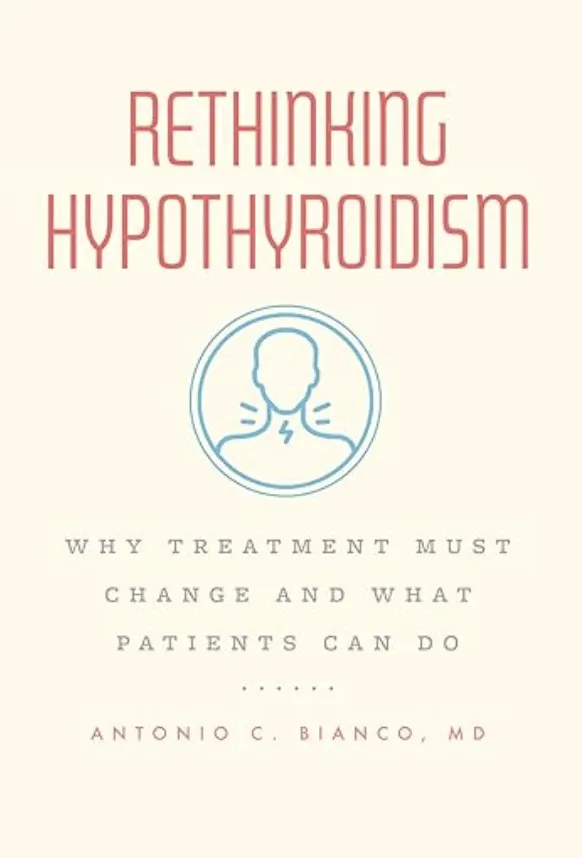
REthinking Hypothyroidism Book cover

Book Review: Rethinking Hypothyroidism by Antonio Bianco MD

December 01, 20256 min read

Book Review

Rethinking Hypothyroidism: Why Treatment Must Change and What Patients Can Do, By Antonio Bianco MD

When a former president of the American Thyroid Association publishes a book for the lay public titled Rethinking Hypothyroidism, the medical world should pay attention. For those of us who have spent years watching mainstream thyroid care fall short for millions of patients, this book raises an important question: is the field finally ready to evolve? Dr. Antonio Bianco is not a fringe figure. He is an academic leader, a medical school dean, and a pioneering thyroid researcher. His lab has shaped much of what we understand about thyroid hormone conversion. So when he challenges the status quo, it matters.

As a thyroid surgeon turned thyroid patient—and now a physician who treats patients with complex thyroid and hormone dysfunction—I approached this book with genuine hope. What I found was a mix of candid scientific truth, revealing history, and a few disappointing blind spots that still hold back progress.

One of the most validating aspects of Rethinking Hypothyroidism is that Bianco openly states what patients and many clinicians have known for decades. T4-only therapy produces poorer outcomes. Patients treated solely with Levothyroxine show higher mortality, more weight gain, more cardiovascular disease, worse lipid profiles, higher statin use, reduced cognitive function, and lower quality of life. These are published outcomes, not opinions. He also acknowledges that T4 therapy lowers circulating T3 in many people—a fact that undermines the entire “TSH-only” treatment model still taught in medical training. At least 20% of patients do not improve symptomatically on T4 despite a normal TSH. Dr Bianco calls attention to these people, who have been ignored for decades and told to seek psychiatric help. He acknowledges that he, like most others in the world of endocrinology, wrongly dismissed these patients in his practice for years.

Bianco even proposed a name for these people's condition: SORSHOT—Syndrome of Residual Symptoms of Hypothyroidism on T4. He acknowledges that adding T3 to their thyroid replacement improves symptoms and metabolic markers for many patients. He encourages endocrinologists to listen to the patients when they don't symptomatically improve and consider prescribing T3. This is a significant statement from someone with his influence.

A large portion of the book explores the history of thyroid treatment from an insider's perspective: who discovered what, and how treatment norms evolved. Bianco doesn’t hide the uncomfortable truth. Dessicated thyroid was not abandoned because it was unsafe or ineffective; it was pushed aside as Synthroid’s manufacturer sought market dominance. There were no superiority studies, no safety data showing advantage over natural thyroid, and no evidence that T4-only therapy was better. But there were strong financial incentives and influential academic partnerships. This history is essential to understanding why thyroid care remains so rigid today.

Bianco touches on the creation of TSH dogma but doesn’t fully unpack it. In the 1970s, several unproven assumptions hardened into clinical “truth”: that a normal TSH means optimal thyroid function, that T4 always converts adequately to T3, and that natural thyroid is inferior and should be avoided. These ideas were encoded into the first ATA guidelines in 1995 and have hardly changed since. Medical students and residents are still trained that if the TSH is normal, the thyroid is fine. This belief has harmed millions, as they were arbitrarily taken off their Armour thyroid and switched to "superior" Synthroid. The parallel with the WHI depriving women of their hormone replacement in the early 2000's is uncanny, since thyroid disease overwhelmingly affects women.

Despite its strengths, the book avoids several critical issues that shape real-world thyroid care. First, most thyroid patients are not treated by endocrinologists at all; primary care physicians manage the majority of care and often feel forced to follow rigid guidelines to the letter even when patients do not improve.

Second, there is minimal practical advice in this book for patients who remain symptomatic. His guidance amounts to asking politely for a tiny dose of T3, accepting TSH as the main monitoring tool, and waiting for long-acting T3—insufficient for those who remain sick.

Third, his messaging about T3 dosing conflicts; podcast discussions point to a 3.5:1 T4:T3 ratio as optimal, yet in the book he recommends ratios of 10:1 or even 15:1. He notes that T3 is short acting but does not explicitly recommend split dosing, and acknowledges that high T4 suppresses T3 conversion without teaching physicians how to adjust T4 accordingly.

He also remains overly cautious about T3 despite the fact that there are no studies demonstrating harm from physiologic T3 use. The reputation of T3 as “dangerous” is built almost entirely on theoretical concerns—not on clinical evidence—because comparative safety studies were never conducted. Meanwhile, we do have evidence that overtreatment with T4 or any thyroid hormone accelerates bone loss, and untreated hypothyroidism does the same. Yet T3 continues in the guidelines as “not recommended,” not because the data support that position, but because tradition and guideline culture have allowed this assumption of harm to persist.

Another major omission is that Bianco does not address TSH reference range controversies. There is no discussion of how ranges were constructed, why they were narrowed recently, or how poorly they correlate with patient well-being. He also dismisses the importance of Reverse T3 outright, despite research to the contrary, labeling it “dead.”

Perhaps the most disappointing position in the book is this: if your TSH is normal, you do not have hypothyroidism, regardless of symptoms, regardless of T3 levels, regardless of Hashimoto's antibody status, regardless of metabolic or cognitive dysfunction. This contradicts his own detailed explanations of how complex and fragile T3 delivery is within the body. If the pathway has multiple failure points, relying on a single pituitary hormone to define the diagnosis is irrational. This is the book’s greatest blind spot.

Despite its limitations, Rethinking Hypothyroidism is still an important book. It signals an internal shift in the rigid world of endocrinology, acknowledges failures in the current model, and opens the door—however slightly—for T3 use in mainstream endocrinology. But true progress will not come from waiting another decade for long-acting T3 or for large institutions to rewrite outdated guidelines. Real progress will come from clinicians who listen to their patients, measure more than TSH, understand thyroid physiology deeply, and prioritize patient well-being over compliance with outdated guidelines. The future of thyroid care will be built by doctors willing to do more.

If you’re a clinician who wants to know why patients remain sick despite “normal” labs, how to use currently available commercial insurance covered labs to guide safe and effective T3 therapy, and how to interpret thyroid labs beyond TSH, you can join the interest list for my physician training program, The New Endocrinology, at https://thyroidclarity.com/endo-optin

Dr Gibbs is a Texas based ENT surgeon turned integrative thyroid and hormone expert. She sees patients in her private clinic in Southlake and by virtual link in multiple states in the USA

Dana Gibbs MD

Dr Gibbs is a Texas based ENT surgeon turned integrative thyroid and hormone expert. She sees patients in her private clinic in Southlake and by virtual link in multiple states in the USA

LinkedIn logo icon
Instagram logo icon
Youtube logo icon
Back to Blog